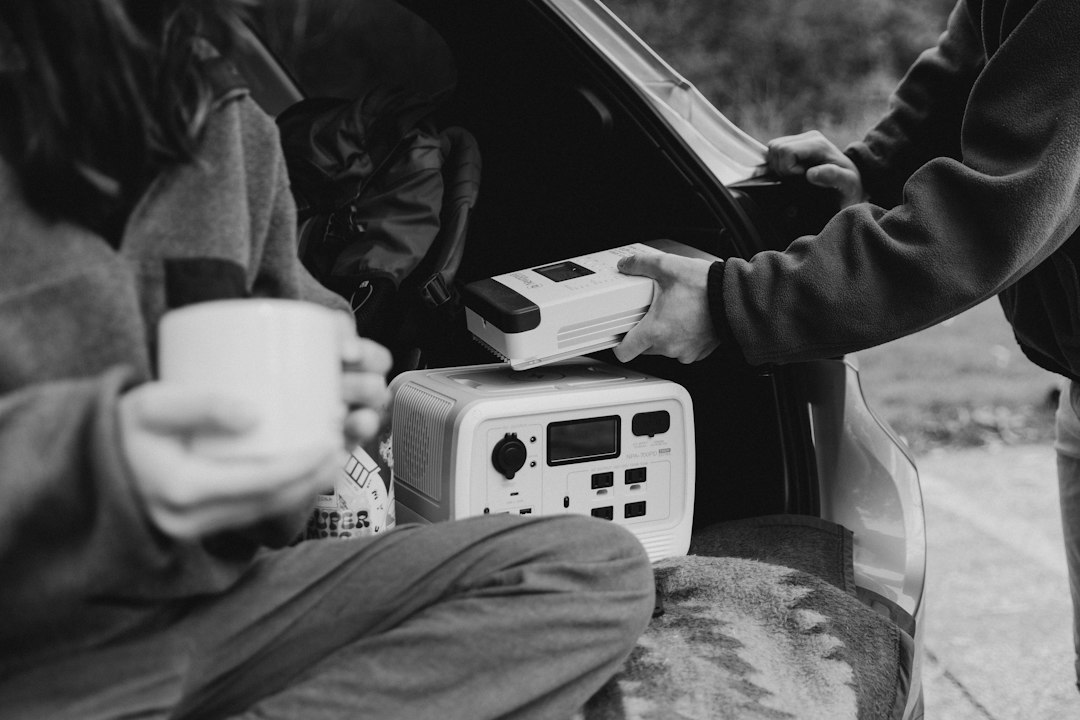
A car power station is a battery box you charge from a 12V socket, a wall outlet, or a solar panel, then carry inside when the grid drops. There is no engine, no fuel, and no exhaust. In Ontario that last part matters more than most buyers realize. Ice storms and freezing rain take out rural feeders for days, and a gasoline generator sitting in a freezing garage brings carbon monoxide risk plus a fuel rotation chore with it. A power station rides in the trunk, tops up on your commute, and comes indoors when the lights go out. Our best portable power station guide covers the whole category. This piece stays narrow: units that live in or around a vehicle.
I have installed transfer switches, sized standby units, and watched homeowners pay for wattage they never use. The five options below were picked on four criteria that actually decide whether a car power station earns its place. How fast does it recharge from a 12V accessory socket? How much continuous load does it hold without tripping? What does it weigh when you carry it up basement stairs in the dark? Does the label carry recognized safety certification? Capacity claims on a box print are easy. Sustained output into a fridge compressor at minus 15 Celsius is the real test. If your plan leans toward a fuelled machine instead, our portable generator picks for 2026 are the parallel read. Both approaches work. They fail in different ways.
Ontario distribution is reliable most of the year. The failure mode is not gradual, though. One freezing rain event can leave a rural feeder dark for three days while the highway stays clear enough to drive. That window is exactly what a car-charged battery covers. Anything wired into house circuits has to be done properly, or not at all. Portable units plug directly into an appliance, which sidesteps permits entirely. The CSA Group publishes the electrical and battery safety standards that certified units carry, and the mark on the label is the first thing to check before you spend money. The EV home backup route opens a second path, using the vehicle itself as the battery bank.
Three numbers decide whether a car power station does the job. Continuous output in watts is what it holds indefinitely. Surge watts is the two-second spike a fridge compressor or a sump pump needs at startup. Usable watt hours is the tank. A 1,000Wh unit running a 90W CPAP machine for 10 hours is a different tool than a 2,000Wh unit holding a fridge through an eight hour outage. Two more numbers get ignored and then cause complaints. Recharge time from a 12V socket runs 10 to 24 hours, far slower than people expect. Weight runs 24 to 48 pounds, which matters when the power is out and the stairs are dark.
How Do the Top Options Compare?
| Option | Best For | Capacity | Continuous / Surge | Check Price |
|---|---|---|---|---|
| EcoFlow DELTA 2 Max | Whole-fridge backup charged from the car | 2,048Wh LFP | 2,400W / 3,400W | Check price |
| Jackery Explorer 1000 v2 | Living in the trunk year round | 1,070Wh | 1,500W / 3,000W | Check price |
| BLUETTI AC180 | CPAP and medical devices on UPS mode | 1,152Wh | 1,800W / 2,700W | Check price |
| Generac GB1000 | Generac owners who want dealer support | 1,030Wh | 1,000W / 2,000W | Check price |
| EV vehicle-to-load (F-150 Lightning, Ioniq 5) | Using the vehicle as the power source | 77 to 131kWh pack | 3,600W / 9,600W | Dealer order |
Specs are manufacturer figures and change between production runs, so confirm the label on the unit you receive. No prices are listed here because they move weekly. Every battery unit on this list should carry a recognized certification mark before it goes into a bedroom or a basement. The vehicle-to-load row is not a battery box you can buy. It only counts if you already own or plan to buy the vehicle, and any panel connection requires a permit and a licensed electrician in Ontario.
1. EcoFlow DELTA 2 Max , Best overall for home backup charged from a car
EcoFlow’s DELTA 2 Max stores 2,048Wh in LFP cells, holds 2,400W continuous, and surges to 3,400W in X-Boost mode. That is enough to start a residential fridge compressor and keep it cycling. Run the math on a 600W fridge at roughly 35 percent duty cycle and you get about 210Wh per hour, so the bank carries it for around eight hours before a top-up. LFP chemistry is rated near 3,000 cycles to 80 percent capacity, which is a decade of light use rather than the three years a cheaper NMC pack delivers. Check price
Charging from the car is the part buyers underestimate. A 12V accessory socket hands over about 100W, so a full recharge takes roughly 20 hours of driving. Two commutes a week keeps it full. A household outlet does the same job in about 80 minutes, and the solar input accepts up to 1,000W, which is faster than most portable setups manage. Fan noise under a heavy load lands near 45 dBA at one metre. You will hear it in a quiet room. You will not hear it over a generator, because there is no generator. The unit weighs 48 pounds and needs two hands.
The DELTA 2 Max accepts add-on batteries, so a single extra pack takes the bank to 4,096Wh without buying a second inverter. EcoFlow publishes discharge curves and efficiency figures on its product pages, which is more transparency than most brands offer. The honest downside is cost per watt hour. You are paying for cycle life and surge headroom. If your load is a router, a phone, and two lamps, this is roughly three times the unit you need. Runtime math for household loads sits in our guide to how long a power station runs a refrigerator.
Key strengths:
- ✅ Holds 2,400W continuous, enough to run a fridge and a freezer together without tripping
- ✅ LFP cells rated near 3,000 cycles, so the pack outlives three cheaper NMC units
- ✅ Accepts add-on batteries up to 4,096Wh with one pack from a single inverter
- ✅ Full wall recharge in about 80 minutes, which is the fastest in this group
- ✅ Fan noise near 45 dBA stays well below any fuel-burning generator
- ❌ Car charging at roughly 100W means about 20 hours of driving for a full tank
- ❌ 48 pounds is a real lift up stairs and not a one-hand carry
- ❌ Highest cost per watt hour on this list, which is hard to justify for light loads
Who it’s for: Ontario homeowners who want a single battery that runs the fridge overnight and tops itself up on the daily commute.
2. Jackery Explorer 1000 v2 , Best for leaving in the trunk year round
The Explorer 1000 v2 carries 1,070Wh and pushes 1,500W continuous with a 3,000W peak. It weighs 24 pounds, light enough to move with one hand and small enough to sit behind a seat. That form factor is the entire argument. A unit that lives in the car gets charged on every drive. A unit that lives in the basement gets charged once and then forgotten until the night you need it, which is usually the night it is sitting at 40 percent.
Runtime is where the smaller tank shows. A 90W CPAP machine draws roughly 10 hours from a full charge once inverter losses are counted. A 600W fridge at normal duty cycle gets about four hours. Both numbers are useful for an overnight outage and thin for a three day one. If a long rural outage is your realistic scenario, plan two units or step up to the 2,000Wh class above.
Charging from the 12V socket takes about 11 hours of driving. Wall charging runs about 100 minutes. Solar input is capped at 400W, so one 200W panel refills it in roughly five hours of solid sun. There is no expansion battery port, so what you buy is what you own. The 3,000W surge covers a fridge or a small sump pump startup, and the app tracks input and output so you can see exactly what each appliance costs you in watt hours.
Key strengths:
- ✅ 24 pounds makes it the easiest unit here to move between car and house
- ✅ 1,500W continuous with a 3,000W peak starts a fridge compressor without tripping
- ✅ About 10 hours of CPAP runtime from a single charge covers a full night of sleep apnea therapy
- ✅ Wall recharge in roughly 100 minutes, so it recovers fast between outages
- ✅ App monitoring shows real watt draw per appliance, which teaches you your own load list
- ❌ No expansion battery port, so 1,070Wh is the hard ceiling
- ❌ About 11 hours of driving for a full car charge is slow for anyone with a short commute
- ❌ Solar input capped at 400W makes off-grid refills a multi-hour project
Who it’s for: Drivers who want a light, always-charged battery in the trunk for overnight outages and roadside use.
3. BLUETTI AC180 , Best value with UPS mode for medical devices
BLUETTI’s AC180 sits in the middle of the range with 1,152Wh, 1,800W continuous, and a 2,700W surge. It weighs 35 pounds. The headline feature for a car-based kit is uninterrupted power supply mode, which switches to battery in about 20 milliseconds when shore power drops. That is fast enough that a CPAP machine or a desktop computer will not reboot. For anyone running home medical equipment overnight, that switchover speed is the difference between a quiet night and a hospital visit. Our guide to emergency power for medical equipment covers the load planning in more detail.
Recharging is quick on household current. The AC180 pulls around 1,440W from a wall outlet and reaches 80 percent in roughly 45 minutes. From a 12V socket it draws closer to 100W, so plan on about 12 hours of driving for a full charge. That gap is the most common surprise for new owners. Car charging is a maintenance trickle, not a fast fill, and no unit in this class changes that.
Capacity does not expand. There is no battery port on the AC180, so 1,152Wh is the ceiling. A 600W fridge at normal duty cycle runs about five hours. A 90W CPAP runs 10 to 11 hours. The 2,700W surge starts a fridge compressor or a small sump pump without tripping the inverter, and the unit handles a furnace blower for short bursts if you manage the load list carefully. For the money, the watt-per-dollar figure is the strongest on this list. Check the BLUETTI AC180 on Amazon.
Key strengths:
- ✅ 20 millisecond UPS switchover keeps a CPAP or desktop running through a blackout
- ✅ 1,800W continuous and 2,700W surge handle fridge and sump pump startups
- ✅ About 45 minutes to 80 percent on wall power, among the fastest in its class
- ✅ Strongest watts-per-unit-capacity value of the five options here
- ✅ 35 pounds is manageable for one person on stairs
- ❌ No expansion battery port, so 1,152Wh cannot grow
- ❌ Roughly 12 hours of driving for a full 12V car charge
- ❌ Smaller tank than the DELTA 2 Max, which shows on multi-day outages
Who it’s for: Households running a CPAP or similar device that cannot tolerate a power interruption.
4. Generac GB1000 , Best for Generac owners who want dealer support
Generac is the name Ontario homeowners already know from standby units, and the GB1000 is its portable entry. It stores 1,030Wh, holds 1,000W continuous, and surges to 2,000W. The spec sheet is modest next to the EcoFlow and BLUETTI boxes, and it costs more per watt hour. What you buy is the service network. There are Generac dealers across Ontario who will answer a phone and take a warranty claim, and that matters when the unit is part of a larger home backup plan rather than a camping accessory.
The 1,000W continuous ceiling is the practical limit. A fridge that runs at 600W and surges near 1,800W will start on its own. A well pump or a furnace blower plus that same fridge at the same time will trip the inverter. Anyone heating with a forced air furnace should check the blower nameplate before assuming this unit covers it. Continuous watts is the number that matters. Surge watts only buys you two seconds.
Charging runs about 100 minutes from a wall outlet and roughly 10 to 12 hours from a 12V car socket, which matches the rest of the class. Weight lands near 30 pounds. There is no expansion port. If you already own a Generac standby system, the brand consistency is convenient but not technically necessary. These portables share nothing with a home standby other than the logo, the service phone number, and the same dealer network you would call for either one.
Key strengths:
- ✅ Ontario dealer network with real warranty support and parts availability
- ✅ 2,000W surge starts a fridge compressor on a 1,000W continuous inverter
- ✅ About 30 pounds sits in the middle of the class for portability
- ✅ Overload and temperature protection is conservative, which protects the pack
- ✅ Pairs naturally with an existing Generac standby setup on the same property
- ❌ 1,000W continuous will not run a well pump or furnace blower alongside a fridge
- ❌ Higher cost per watt hour than the EcoFlow or BLUETTI options
- ❌ No expansion battery port and no UPS-grade switchover for sensitive electronics
Who it’s for: Homeowners already invested in the Generac ecosystem who value a dealer phone number over peak specs.
5. EV vehicle-to-load (Ford F-150 Lightning and Hyundai Ioniq 5) , Best when the vehicle itself is the power station

Some new vehicles are the power station. The F-150 Lightning with the 9.6 kW Pro Power Onboard package puts 2.4 kW through the front outlets and 7.2 kW in the bed, drawing on a 131 kWh extended-range pack. Ford claims up to 10 days of home power at low load. That is a whole-house number no portable battery on this list can approach. The Hyundai Ioniq 5 and similar E-GMP cars offer 3.6 kW through vehicle-to-load, enough to run a fridge, a freezer, a router, and lights from a 77.4 kWh pack. Both options turn a driveway into a substation.
There is no engine noise because there is no engine. The truck’s thermal management fans cycle while the pack feeds a load, and that is the only sound you get. Winter changes the math. A pack that runs the house also cannot drive you anywhere until it recharges, and DC fast charging during a regional outage is not guaranteed. Plan the load list around what you need rather than what the outlets can deliver.
Wiring is where this gets serious. Backfeeding a home through a dryer outlet or a homemade generator cord is illegal and dangerous, and it puts utility line crews at risk. Ontario rules require a proper inlet box, an interlock kit or transfer switch, and a licensed electrician. The Electrical Safety Authority regulates that work, and a contractor who skips the permit is not saving you money. The same rules that apply to a portable generator apply here, which is why our generator safety tips are worth reading before you buy the cable.
Key strengths:
- ✅ 9.6 kW total output on the Lightning covers a whole house load, not just a fridge
- ✅ 131 kWh pack delivers days of runtime, far beyond any portable battery
- ✅ Silent operation apart from intermittent battery cooling fans
- ✅ Ioniq 5 and similar cars provide 3.6 kW with no extra equipment purchase
- ✅ No fuel storage, no oil changes, and no carbon monoxide risk at the house
- ❌ The vehicle has to be home and charged, which fails during a widespread outage with road closures
- ❌ Panel connection requires an inlet, interlock or transfer switch, permit, and licensed electrician
- ❌ Cold weather cuts usable pack capacity and slows DC fast charging when you need a refill
Who it’s for: EV and hybrid truck owners who want whole-home backup without buying a second battery system.
Frequently Asked Questions
Can you charge a car power station while driving?
Yes, using the 12V accessory socket and the cable most brands include. Output is limited to roughly 100W, so a full charge takes about 10 to 20 hours of driving depending on capacity. That is enough to keep a unit topped up over a normal week of commuting.
How many watts do I need to run a refrigerator?
Most residential fridges run at 400W to 700W and need a surge of 1,200W to 2,200W for two seconds at compressor startup. A unit with 1,500W continuous and 3,000W surge handles one fridge comfortably. Two fridges or a fridge plus a freezer pushes you toward 2,400W continuous.
Is a car power station the same thing as a generator?
No. A power station stores energy in a battery and produces no exhaust, so it can run indoors. A generator burns gasoline or propane and must never run inside a garage, home, or attached structure because of carbon monoxide.
Can I plug a power station into my house wiring?
Only through a proper inlet box with an interlock kit or transfer switch, installed by a licensed electrician with a permit. Backfeeding through a dryer outlet or an extension cord is illegal in Ontario and can electrocute a utility worker.
Do power stations work in an Ontario winter?
They discharge down to about minus 20 Celsius, so running one in a cold garage is fine. Charging below freezing can damage LFP cells, so bring the unit inside to recharge. Cold also cuts usable capacity by roughly 10 to 20 percent.
How long will a 1,000Wh power station run my devices?
A 90W CPAP machine runs about 10 hours. A 600W fridge at normal duty cycle runs about four hours. A router at 20W plus two LED lamps at 10W each runs well past 30 hours.
What Should You Remember?
- Continuous watts beat capacity when choosing a car power station, because a fridge that runs at 600W still needs a 1,800W surge to start.
- 12V car charging is slow on every unit, running roughly 10 to 20 hours for a full charge, so treat it as a trickle top-up and not a fast fill.
- LFP battery chemistry lasts about three times longer than older NMC packs, which changes the cost per year even when the sticker is higher.
- UPS mode matters more than capacity if you run a CPAP or medical device, since a 20 millisecond switchover prevents a reboot.
- EV vehicle-to-load is a different category at 3.6kW to 9.6kW, but it needs an inlet, a transfer switch, and a permit to connect to a panel.
- Never backfeed a panel through an outlet, since it endangers line crews and violates Ontario electrical rules enforced by the ESA.
- Match the unit to your real load list before you buy, because a 1,000Wh box and a 2,000Wh box solve different problems.
This article is for general information only. Always follow manufacturer instructions, local electrical codes, and hire a licensed electrician for transfer switches and standby generator installation. Carbon monoxide is deadly , never run a generator indoors.